Professional athletes have come to represent the pinnacle of physical ability, serving as a cultural image of performance and physique. With millions watching sporting events, these body ideals have been planted firmly in the mainstream’s consciousness. But what happens when these examples inspire behavior that goes beyond what’s healthy in pursuit of the perfect body?
Eating disorders, including anorexia nervosa and bulimia nervosa, can affect people of any sex or body weight. A person does not have to appear underweight to be seriously unwell.
Restrictive eating, binge eating, purging, and excessive exercise can be warning signs. Men who are concerned about their eating or body image should be able to seek assessment and treatment without stigma. Eating Disorders: What You Need to Know.
So just how much do these images of pro athletes diverge from the average man’s body? How far would men have to go to get the physiques of sports stars?
We compiled statistics from the NFL, MLB, NBA, and other major sports leagues to determine the average body size of players in each field and compared them to the body sizes of men around the world. Read on to learn about the dangerous lengths men would have to go to make these ideals a reality.
The Average Athlete
Because of the basic differences in athletic abilities needed for various sports, each sport averages a different body type standard. For instance, NBA players had the highest average height out of any sport, at a staggering 79.2 inches – 5 inches more than the runner-up, NFL players. And NFL players had the greatest average weight at 246.9 pounds, nearly 25 pounds more than the average NBA player.
In terms of body mass index (BMI), a relationship between height and weight that does not take into account body fat percentage, NFL players had the highest BMI of all at 31.5, while pro tennis players had the lowest at 22.8.
Due to the diversity of these body types, each can have a very different impact on men’s body anxieties as well – especially on male athletes themselves. The average man has a BMI of 26.66 and a weight of 181.9 pounds and would have to gain a substantial amount of weight, largely in muscle, to approach the most common body types in the NFL and NBA.
Muscle dysmorphia, a condition of men who continually believe they aren’t muscular enough, has been described as a “reverse anorexia.” This condition can be characterized by an unhealthy preoccupation with frequently working out and a highly regimented diet focused on gaining weight.
Sufferers of muscle dysmorphia may experience depression and anxiety as well as a serious impact on their work and social life; they may also engage in steroid abuse in order to achieve a highly muscular body shape.
The struggle to achieve a perfect physical ideal can give rise to body dysmorphia, disordered eating, purge behaviors including excessive exercise, and abuse of pharmaceuticals that include laxatives and stimulants, or illicitly obtained anabolic steroids.
Ultimately, this quest has very little to do with health – a fact made evident as one’s mental and physical well-being quickly fall by the wayside. If eating disorders and their related consequences are challenging your attempts to lead a normal and healthy life, call . Treatment support advisors are available to provide more information about recovery options.
The Average Man
Scroll horizontally to see all columns.
| Survey | Population | Finding |
|---|---|---|
| Greece, 2019 | Men aged 15 and over | 49.2% overweight; 16.6% obese |
| Australia, 2022 | Adult males aged 18 and over | 71.2% overweight or obese |
National statistics describe populations, not an ideal body for any individual. The updated table reports BMI categories from two newer official surveys. Greece’s 2019 results use self-reported height and weight among people aged 15 and over.
Australia’s 2022 adult estimates use measurements supplemented by imputation where measurements are missing. Differences in methods, age coverage, and year prevent a simple comparison. BMI also does not distinguish muscle from fat.
Comparing the Two
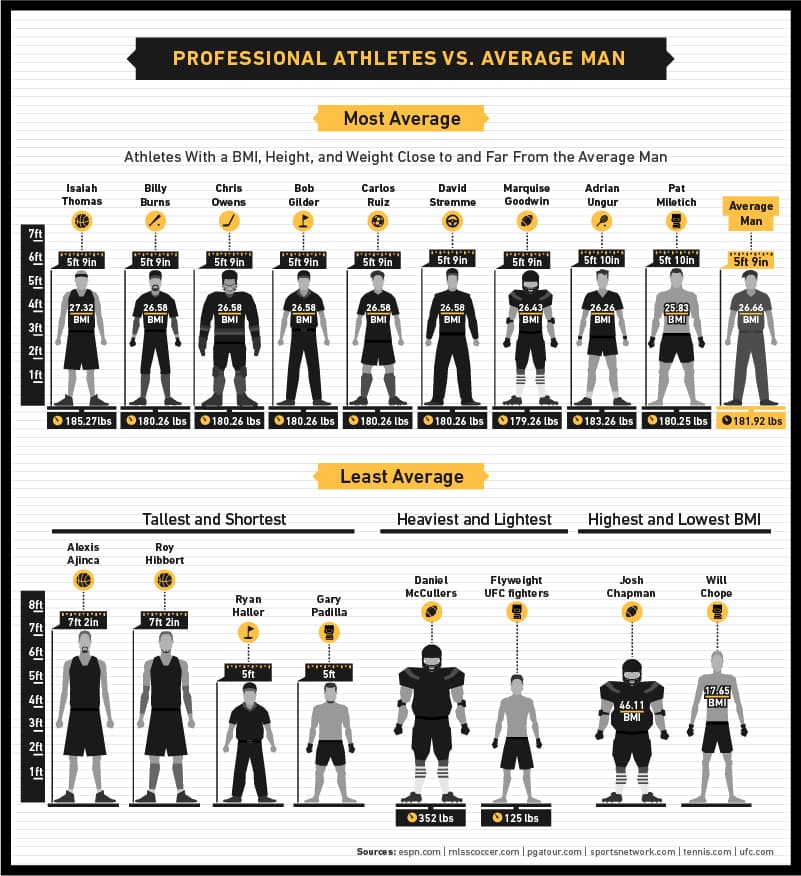
Professional sport is all about the extremes of physical ability, and we analyzed the stats of U.S. pro sports players to identify the biggest, smallest, and most average players. As you might expect, the tallest players overall were from the NBA, with Alexis Ajinca and Roy Hibbert tied at 7 feet 2 inches.
Meanwhile, the shortest were golfer Ryan Haller and UFC fighter Gary Padilla, both at an even 5 feet 0 inches. The heaviest player amongst all major league sports was the NFL’s Daniel McCullers at 352 pounds, while the lightest would fall into the UFC’s flyweight class at 125 pounds.
However, we also looked at the athletes who most closely aligned with the BMI, height, and weight of the average man. Among the NBA, the “most average” player is Boston Celtics point guard Isaiah Thomas at 5 feet 9 inches and 185 pounds, while Olympic athlete Marquise Goodwin is the most typical among the NFL.
Height, Weight, and BMI of Athletes in the NFL, NBA, MLB, and NHL
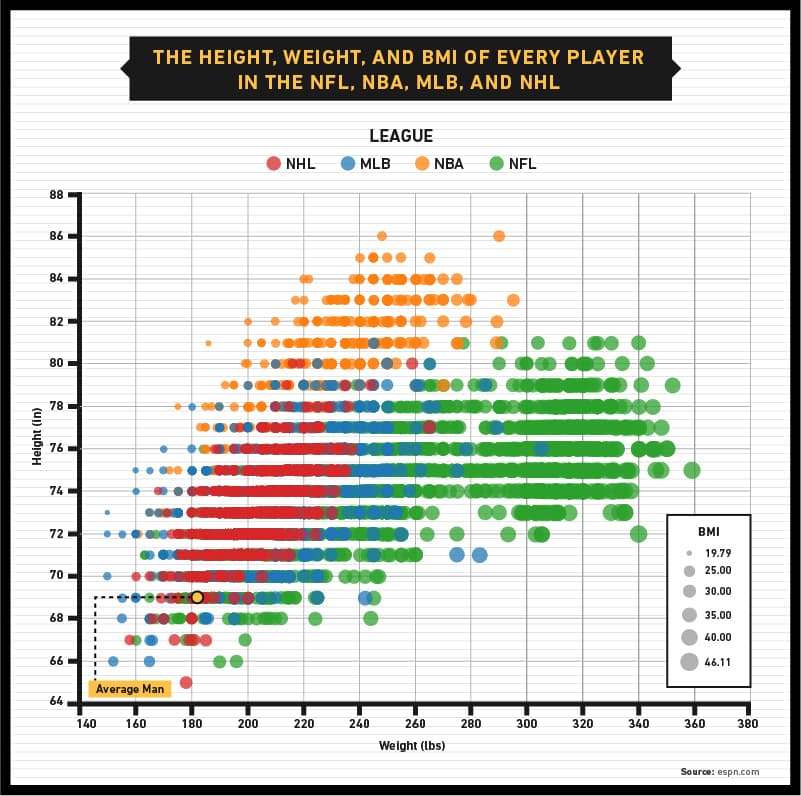
Using the stats of every player in the NFL, NBA, MLB, and NHL, we charted individual body sizes throughout these four major leagues to see which patterns emerged. As we’ve seen, NFL players tend toward greater weight and higher BMI, whereas NBA players show a greater height than any other sport.
However, we can see that in comparison, MLB players tend to be both shorter and less heavy, and NHL players typically have even smaller body sizes. These are sports where the extremes of height or weight provide less of an inherent advantage to players, who must rely on other skills and abilities.
Average Baseball Players’ Sizes Over Time
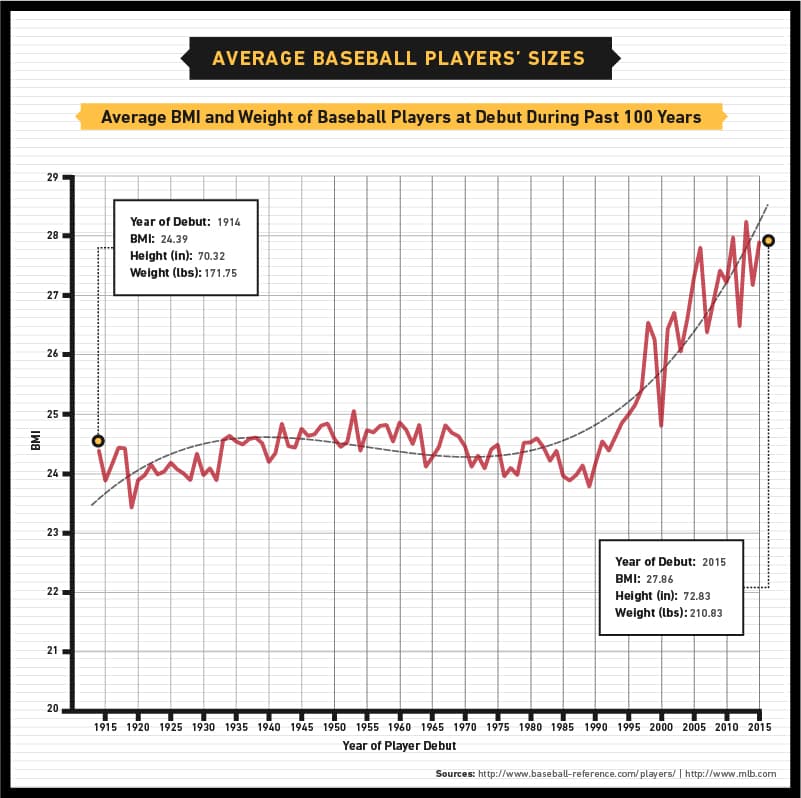
One notable sport for which pro players remain relatively close to the average man’s BMI is major league baseball. The popular national pastime featured players with an average BMI of 26.54 in 1998, 27.21 in 2010, and 27.86 in 2015, approaching the average U.S. man’s average BMI of 28.6.
But while many men would be able to meet these size standards, it’s an altogether different matter whether they could achieve the same physique, and these ideals can worsen the body dissatisfaction that can contribute to eating disorders.
If concerns about eating, exercise, or body image are affecting your health or daily life, talk with a health care professional. A primary care provider can help assess your concerns and refer you for eating-disorder treatment. Treatment may include psychotherapy, nutritional counseling, medical monitoring, and care for co-occurring conditions. Eating Disorders: What You Need to Know.
Collegiate Athletes Compared to the Pros
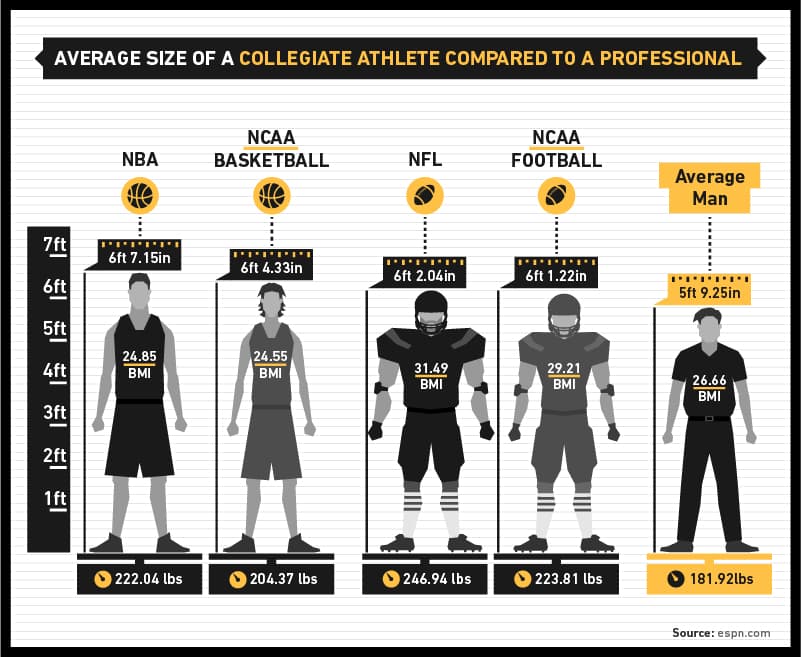
It’s not just the average man whose physique is far from that of major league players. Even the average collegiate basketball and football players don’t match the body size of NBA and NFL athletes.
The average NCAA basketball player is still almost 3 inches shorter than the average NBA player, and almost 18 pounds lighter. And the typical NFL player is 23 pounds heavier than the average NCAA football player.
Male athletes actually face some of the highest risks of eating disorders and unhealthy body image.
These athletes are subject to pressures to perform, constant evaluation and scrutiny of their abilities, and the weight limits inherent to their sport. These pressures can lead to body dissatisfaction, influencing the development of disordered eating behaviors and excessive exercise.
Average Sizes by Position of Collegiate and Pro Athletes
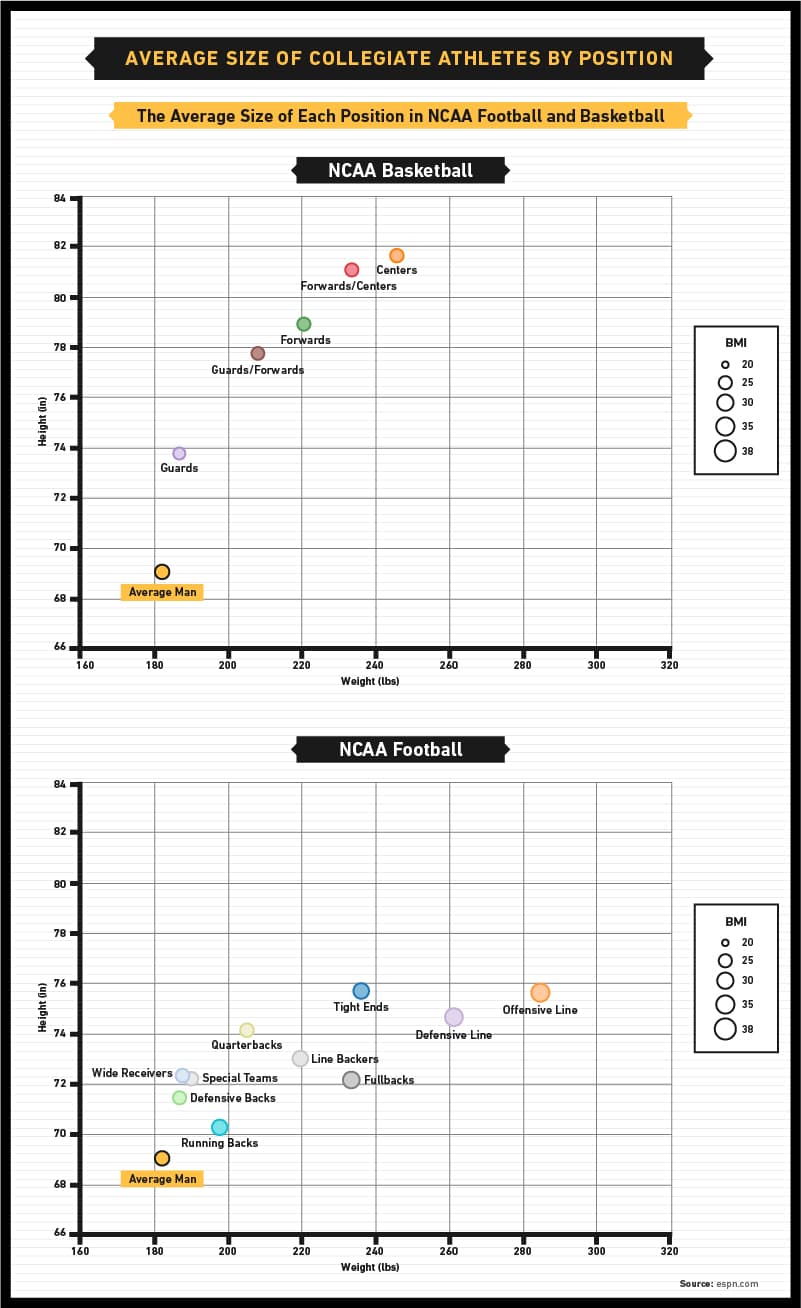
We also looked at the body size statistics for different positions among NCAA basketball and football players. As you might expect, basketball players trend toward a greater height, while football players trend toward higher weights.
Similarly, BMI tended to be greater among football players than basketball players. The overall tallest body sizes are occupied by center and forward/center positions in basketball, both exceeding 6 feet 8 inches on average. In NCAA football, the heaviest body size is that of the offensive lineman, who weighs an average of over 280 pounds.
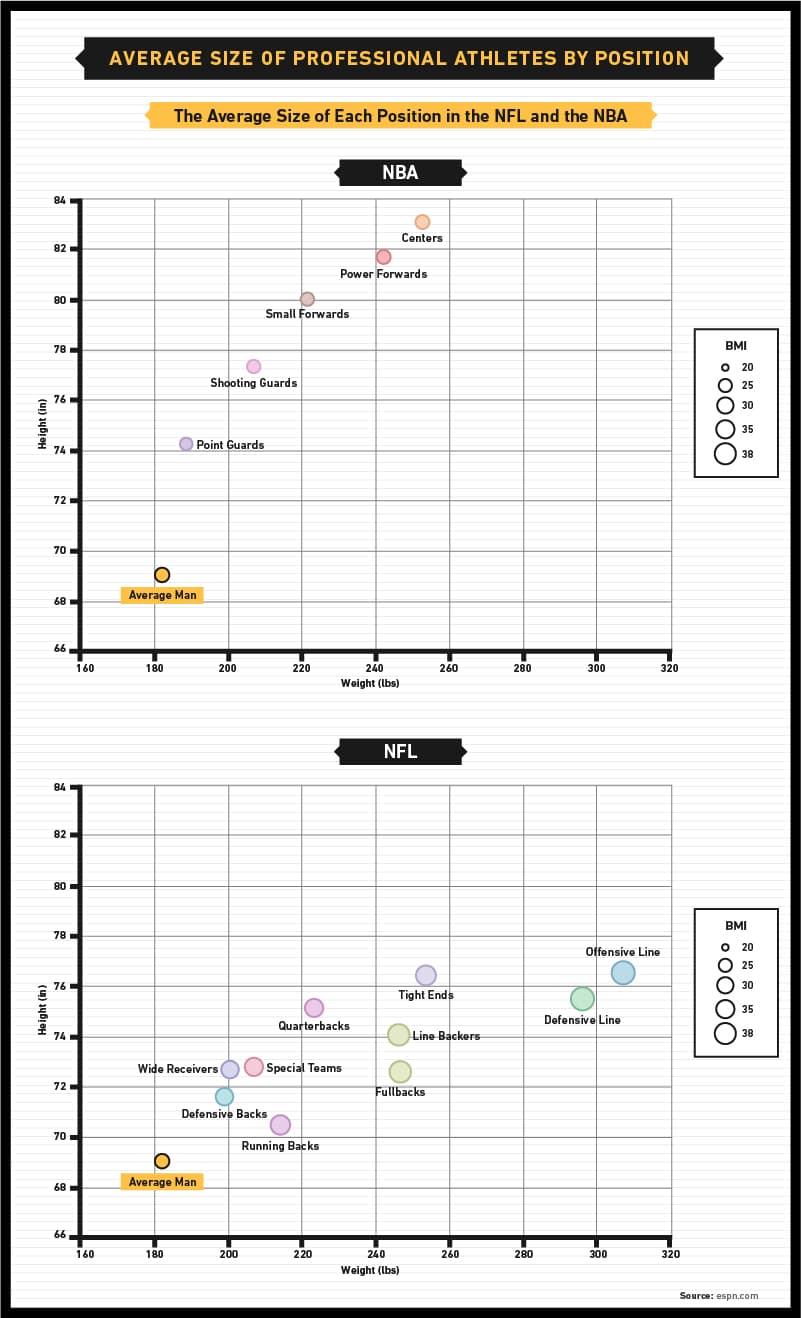
When we analyzed the typical body sizes among different positions in the NBA and NFL, the trend of increased body size in the major leagues became even clearer. As with NCAA basketball players, centers and power forwards remain the top NBA players by average height – but NBA centers are an average of 6 feet 11 inches.
NFL players also exceed the average body size of NCAA football players, with pro offensive linemen weighing over 300 pounds on average. These substantial differences further illustrate pressures of body size and shape on collegiate athletes who face fierce competition to reach the major leagues.
Eating Disorders Among Collegiate Athletes
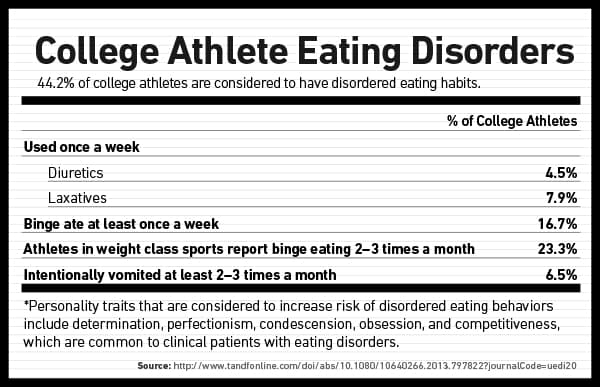
Make no mistake: The pressures of an ideal athletic image can be actively damaging to health. A recent study has revealed that male collegiate athletes engage in unhealthy and dangerous weight control behaviors at staggering rates.
In the study, 16.7 percent of players reported binge eating at least once a week, and 6.5 percent induced vomiting at least two to three times a month.
In addition, 7.9 percent used laxatives once a week, and 4.5 percent used diuretics once a week – with 23.3 percent of athletes in sports with weight classes reporting binge eating two to three times a month.
Vomiting and other purging behaviors can lead to digestive problems, tooth erosion, esophageal inflammation, and electrolyte imbalance that can cause arrhythmia and even death. In the pursuit of a “perfect” figure, these athletes risk severely harming their bodies and their health.
Seeking Help for Eating Disorders and Body Dissatisfaction
Men face a variety of social pressures to attain an ideal, trim, muscular image, and these influences can push them to an unhealthy extreme.
If getting fit has turned into a harmful compulsion, know that help is available.. Professional assistance as part of a tailored treatment program has helped many regain control of their lives and health. Visit PsychGuides.com today – peruse our informational pages and/or utilize our state treatment directories to find the help you need to achieve the well-being you deserve.
Fair Use
Feel free to use any of the assets found on this page. In doing so, we ask that you give credit to the creators by linking back to the original project, which allows your audience to explore other elements of the project and methodology.
Methodology
Using import.io, a tool that allows users to crawl websites and extract data, we pulled male athletes’ online player profiles, which included heights and weights as well as information on hometowns and countries.
Given the height and weight of each athlete, we were able to calculate his BMI. We compiled all the data we scraped, as well as our BMI calculations, and we used them to determine the average height, weight, and BMI – along with nationalities when applicable – for each athlete and his respective sport.
The original athlete graphics use historical player statistics and a mixed-year population benchmark. They are retained as historical illustrations, not current population estimates or targets for personal weight change. The national comparison table has been replaced with newer official BMI-category findings for Greece and Australia; those replacement references support the new table, not the old athlete calculations.
References
- ESPN.com. (n.d.). ESPN - Serving Sports Fans. Anytime. Anywhere. ESPN.com. ESPN. Accessed October 10 2026.
- mlssoccer. (n.d.). mlssoccer. MLS. Accessed October 10 2026.
- [Referenced web resource]. (n.d.). PGA TOUR. PGA TOUR.
- [Referenced web resource]. (n.d.). sportsnetwork.com. sportsnetwork.com.
- Tennis.com. (n.d.). Tennis Scores, Tournaments, Rankings & News. Tennis.com. Tennis.com. Accessed October 10 2026.
- The Official Home of Ultimate Fighting Championship | UFC.com UFC UFC Play Play Play Play Play Play Play Play Play Play Play Play Play Play Play Play Play Play Play Play threads threads threads threads threads threads threads threads threads threads. (n.d.). UFC. Accessed October 10 2026.
- [Referenced web resource]. (n.d.). Baseball Reference. Baseball Reference.
- WebMD. (n.d.). Guys Get Eating Disorders, Too. WebMD. WebMD. Accessed October 10 2026.
- [Referenced web resource]. (n.d.). National Library of Medicine. National Library of Medicine. Accessed October 5 2026.
- Bulimia: MedlinePlus Medical Encyclopedia. (n.d.). MedlinePlus. Accessed October 10 2026.
- OASH | Office on Women's Health. (n.d.). Bulimia nervosa | Office on Women's Health. OASH | Office on Women's Health. Office on Women’s Health. Accessed October 10 2026.
- Mehler PS, & Rylander M. (2015). Bulimia Nervosa - medical complications. Journal of eating disorders, 3, 12. National Library of Medicine.
- Galli, N., Petrie, T. A., Reel, J. J., Chatterton, J. M., & Baghurst, T. M. (2014). Assessing the validity of the Weight Pressures in Sport Scale for Male Athletes. Psychology of Men & Masculinity, 15(2), 170–180. APA PsycNet. Accessed October 5 2026.
- [Referenced web resource]. (n.d.). National Library of Medicine. National Library of Medicine. Accessed October 5 2026.
- [Referenced web resource]. (n.d.). National Library of Medicine. National Library of Medicine. Accessed October 5 2026.
- [Referenced web resource]. (n.d.). cdn.intechopen.com:443. cdn.intechopen.com:443. Accessed October 10 2026.
- Taylor & Francis. (n.d.). Taylor & Francis.
- Petrie, T., Galli, N., Greenleaf, C., Reel, J., & Carter, J. (2014). Psychosocial correlates of bulimic symptomatology among male athletes. Psychology of Sport and Exercise, 15(6), 680–687. ScienceDirect.
- Taylor & Francis. (n.d.). Taylor & Francis.
- Hellenic Statistical Authority. (2020). Health Survey: 2019. ELSTAT. statistics.gr. Accessed October 10 2026.
- [Referenced web resource]. (n.d.). destatis.de.
- [Referenced web resource]. (n.d.). pisa2006.helsinki.fi. pisa2006.helsinki.fi.
- Organisation for Economic Co-operation and Development. (2009). Society at a glance 2009: OECD social indicators. OECD Publishing. OECD. The link opens the complete report containing the originally cited section.
- BBC News. (n.d.). Statistics reveal Britain's 'Mr and Mrs Average'. BBC News. bbc.com. Accessed October 10 2026.
- Schönbeck, Y., Talma, H., van Dommelen, P., Bakker, B., Buitendijk, S. E., HiraSing, R. A., & van Buuren, S. (2013). The world’s tallest nation has stopped growing taller: The height of Dutch children from 1955 to 2009. Pediatric Research, 73(3), 371–377. PubMed. Accessed October 5 2026.
- Australian Bureau of Statistics. (2023). Waist circumference and BMI, 2022. ABS. abs.gov.au. Accessed October 10 2026.
- [Referenced web resource]. (n.d.). www1.imperial.ac.uk.
- FastStats. (2025). CDC. Accessed October 10 2026.